Monday, April 1, 2013

Investigation Using a Secondary Source

I have two primary sources from EyeWitness to History.com. One of these primary sources is a letter by Dolly Madison to her sister about the moments just prior to the British taking the White House. I have several questions about this source. First of all, I wonder if this is one letter or multiple letters. EyeWitness to History.com seems to indicate that this is one letter. However, the letter is broken into three time frames. 1. The day after President Madison left to join General Winder, 2. "Wednesday Morning, twelve o'clock," and 3. Wednesday at Three o' clock. This could indicate that this letter is actually multiple letters. However, I can see how Dolly could have written about three different times all within the same letter; especially if she is writing to her sister years after the fact with the purpose of recounting the events leading up to the British capture of the White House. This leads me to my next question.When was this letter written? The letter itself indicates that it was written just before the British attacked and took the White House. Dolly Madison begins the letter with, "My husband left me yesterday morning to join General Winder." The rest of the first part of this letter (the next four paragraphs) is written in the present tense indicating that it was written the day after President Madison left to join General Winder. The second part of the letter occurs on "Wednesday at 12 o'clock." The third part occurs at 3 o'clock on Wednesday. Both of these sections are written in the present tense. My final question is, why did Dolly write this letter to her sister? Was it simply to recount Dolly's last moments in the White House before she had to leave because of the British invasion, or was there another reason?
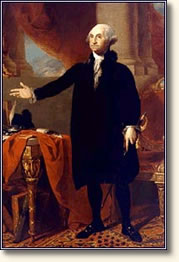
What I do know about this source is that it was written by Dolly Madison to her sister. I also know that the events described make sense with what we know about what occurred in the moments before the British invaded Washington, and eventually the White House. I know that the first lady was in the White House as the British were approaching and that she took many valuables (including the famous painting of George Washington) with her as she escaped.
My other source from EyeWitness to History.com is The British Burn Washington, DC, 1814. I have two major questions pertaining to this source. My first question is, why did George Gleig write about the destruction of Washington? Was his purpose to have a personal journal about this major event in his own life, or was it to record an official account for British records? My next question is, who is George Gleig? EyeWitness to History.com makes it clear that Gleig was part of the British forces that attacked Washington. What I am questioning is whether Gleig was a soldier or just some kind of recorder that followed the army around.
What I know about this source is that George Gleig is the author. I know that "George Gleig was part of the British force that attacked and burned Washington." (EyeWitness to History.com) I also know that this source describes events that I am familiar with. The British invaded the White House and ate a meal that had been prepared for the return of President Madison. The British army then set fire to any buildings associated with the government.
From EyeWitness to History.com
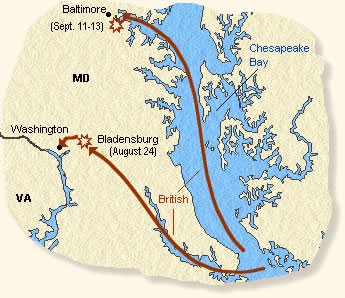
My secondary source about the War of 1812 and the burning of Washington is, 1812 War with America by Jon Latimer. This source is interesting because it comes from a British perspective. With this book, Latimer makes the attempt to provide a comprehensive history about the war of 1812 from a British perspective. However, I am primarily interested in chapter 14, "Burning the White House" because this chapter discusses the British take over and burning of Washington. This chapter begins by explaining officer Cockburn's plan to take Washington D.C because he knows that it will be sparsely defended. This chapter also mentions general Ross who is the general of George Gleig, the author of one of my primary sources. This chapter explains how Ross is very reluctant to attack Washington at first because he fears that it will be well defended. However, Cockburn finally convinces him into taking the offensive risk. This chapter discusses how the British forces traveled up river and then marched in the terrible heat (where several soldiers died of heat exhaustion) toward Washington. The battle of Bladensburg is also described in fairly significant detail in this chapter. 
Portrait of Washington
From EyeWitness to History.com
However, what is of most interest to me is the attack on Washington, which this chapter also discusses in detail. Latimer explains how Ross has no desire to destroy any private property unless the property's owners began causing trouble. Latimer also mentions the episode where Ross begins entering the city and has his horse shot out from under him (his 3rd horse in this trek toward Washington.) This story is mentioned in the journal of George Gleig. My other primary source (the letter by Dolly Madison) is even directly mentioned in this chapter, but unfortunately it does not say when the letter was written. It only says "Dolley later wrote to her sister..." (Latimer 316).  Latimer also explains how President Madison arrived at the White House at 4:30 to get Dolley, but he found out that she had left an hour earlier. Latimer also mentions who took the painting of George Washington from the White House. "It was taken by Jacob Barker, a ship-owner and fellow Quaker, and Robert G.L. de Peyster, "assisted by two colored boys..." (316) Latimer also spends considerable time explaining the British method of burning anything associated with the United States government. He explains how difficult it was for the British to set the Capital Building on fire, how the British set fire to The Library of Congress, and how the British ate the American victory feast at the White House before setting it ablaze. However, Latimer was quick to note that General Ross and Officer Cockburn were polite and considerate towards the civilians who were in Washington at the time of the conquest. After the burning of Washington, Ross and Cockburn quietly left Washington less than 24 hours after they had taken the city. All in all, this secondary source by Latimer thoroughly explains the time frame and events that my primary sources stem from. 

Sources:

 "The British Burn Washington, DC, 1814," EyeWitness to History, eyewitnesstohistory.com (2003).

"Dolley Madison Flees the White House, 1814" EyeWitness to History, www.eyewitnesstohistory.com (2009).

Latimer, Jon. 1812 War with America. Cambridge: The Belknap Press of Harvard University Press, 
2007. Print.

Friday, March 22, 2013

Pre-investigation of Primary Sources

One of my sources is The British Burn Washington, DC, 1814. This source is from EyeWitness to History.com. The majority of this article is made up of an eyewitness account of George Gleig who "was part of the British force that attacked and burned Washington." Gleig seemed to be writing an account of the British attack on Washington DC.
The article from EyeWitness to History.com gives a brief summary of what led up to the August 24th 1814 invasion of Washington. The article also describes the setting of this invasion. Following this introduction, EyeWitness to History provides a primary account of the attack on Washington D.C. This account is about the British invasion from the viewpoint of a British soldier. It contains some very interesting information. It describes how General Ross sent a party to Washington to make a truce of some kind, but this party was fired upon from a house as they entered the city. In this attack the horse of General Ross himself was killed. Gleig then accounts how the British responded to this violation of ethics by killing those in the house and then proceeding "to burn and destroy everything in the most distant degree connected with government." Gleig explains that the British destroyed the Capital Building, White House, a dockyard, arsenal, barracks, a brand new frigate, and many other things connected with the government. He also explains how the British soldiers who invaded the White House ate a feast that had been prepared for the President himself.
From: EyeWitness to History.com
As mentioned above, the author of this first hand account of the attack on Washington was George Gleig who, "was part of the British force that attacked and burned Washington." (EyeWitness to History.com) I am unsure of Gleig's motivation, but I would guess that he wanted to keep a record of what happened as a piece of personal memorabilia. My reasoning for this is that within the portions of the first hand account that appear on EyeWitness to History.com (not all of it is there) there are not many meticulous details. The writing is a kind of style that I would expect in a personal journal rather than in official governmental records. However, this is just conjecture by an undergraduate student, so it could very well be inaccurate.  
The context of this writing was the attack on Washington D.C on August 24, 1814. This attack occurred within the larger context of the war of 1812. Again, the two possibilities that I see for the purpose of this source are either documentation for official British records, or simply informal documentation for personal reasons. In my very uninformed opinion, I would guess that it is the later. 

My second primary source is also from EyeWitness to History.com. This primary source is a letter by Dolly Madison to her sister about the days just prior to the British taking the White House. This letter accounts her expectant waiting for her husband, President Madison and her eventual departure from the White House.
Dolley Madison
From: EyeWitness to History.com
The article from EyeWitness to History.com briefly describes how President Madison sent an urgent message to his wife urging her to flee the White House. It then explains how Dolly Madison hastily fled the White House with important government documents and a now famous portrait of President Washington. This account is followed by a letter that Dolly Madison wrote to her sister that describes her retreat from the White House. In this letter, Dolly accounts how President Madison had left her at the White House to accompany General Winder as the British approached closer to Washington. She explains how she was worried about President Madison and how the President was expressing his worry about her. He expressed this worry through letters that warned her to be ready the leave the White House at sudden notice if the British approached the city. The second section of the letter discusses August 24th. It documents how Dolly Madison has been looking for her husband since dawn, but she sees only soldiers. The final section occurs three hours after the second section. Dolly Madison reports that there has been a battle at Bladensburg, but President Madison has not yet returned to the White House. She then explains how Mr. Carroll and a wagon has come to take her away from the danger, but she is reluctant to go until the wagon is filled with valuables from the White House and the picture of George Washington is secure. The letter ends with Dolly fleeing the White House, uncertain of her fate. 
 Dolly Madison, the wife of President James Madison, is the author of this letter. I am unsure of her motivation because I do not know when this was written. If the letter was written during the events described in 1814, then Dolly's purpose was to keep her sister informed about what was going on concerning her safety and whereabouts. However, EyeWitness to History seems to indicate that this letter was written years after the fact. The letter is introduced on the website with "Some years later, Dolley Madison recreated the scene at the White House that day in a letter to her sister."(EyeWitness to History.com) If this letter was indeed written years after the fact, the purpose could have been to simply share her experience of the event with her sister or to give her sister a dramatized account of the moments before the British invaded Washington.
If this letter was written during the events described, then the context is the War of 1812, specifically the British invasion of Washington on August 24, 1814. The letter would have been written to inform Dolly's sister of Dolly's health and where she was headed. However, if the letter was written years after the fact, the context changes. If it was written years after the fact, then I am unsure of what the context was because I do not know when it was written. If this was the case, I would also be unsure of what led this source to be written.

Sources: "The British Burn Washington, DC, 1814," EyeWitness to History, eyewitnesstohistory.com (2003).

"Dolley Madison Flees the White House, 1814" EyeWitness to History, www.eyewitnesstohistory.com (2009).

Thursday, March 7, 2013

Primary Source for Blog Assignement #2

Dolley Madison
From: EyeWitness to History.com


For this next blog assignment, I will be using two primary sources about the British burning Washington D.C in 1814. Both sources are from EyeWitness to History.com. The first will be "Dolley Madison Flees the White House, 1814. The second will be "The British Burn Washington, DC, 1814."


From: EyeWitness to History.com


Saturday, February 16, 2013

The Lives of African Slaves in Early America

The life of the African slave in early America was a harsh and dehumanizing existence. African slaves had virtually no rights. They were viewed as inferior beings by the white colonists even during the time of the American Revolution where the words, "freedom,""basic human rights," and "liberty" were on the lips of virtually all in America. Even after the American colonists had won "freedom" and independence from the British in 1783, most Africans in The United States were suffering under the bondage of slavery.
Shortly after settlements began appearing on the east coast, it became apparent that making a living in America would take a lot of manpower. There were forests to be cleared and crops to be tended to. In 1619,  "A Dutch ship brings the first permanent African settlers to Jamestown. These Africans soon are put to work on tobacco plantations." (PBS.org) However, the number of slaves in America remained relatively low until the 18th century when the slave population (mostly in the rice and tobacco growing south) exploded. This increase in slaves largely came about as a result of the slave trade across the Atlantic on what is now known as the Middle Passage. This trip was long, deadly, and miserable. The African slaves would be quartered below deck with few rations, and would lie side by side in cramped quarters. There was usually an area in the center of the deck for the purpose of holding human excrement, but many were too sick or cramped to move to this space when they needed to. This environment caused disease to flourish and resulted in many deaths. "On average, about 15 percent of the slaves died, but sometimes half or more perished." (Roark 137)
slave ship
From Africans in America, pbs.org
These slaves experienced little relief when they arrived in the American colonies where they were viewed as property of their owners. "Southern planters expected slaves to work from sunup to sundown and beyond." (139) These harsh expectations caused many slaves to resist their owners. This resistance took many forms. It could be dramatic such as violent rebellion, or a more passive approach such as, working slower, or retaining part of their African culture. Some examples of this are slaves building their homes like their African homes, giving their children family names, worshiping African deities, making and playing traditional African instruments, growing and eating African food, and preforming traditional African funerals. Some of this cultural preservation has survived to this day. The Gullah people who live in South Carolina and Georgia are perhaps the best example of this. "They speak a creole language similar to Sierra Leone Krio, use African names, tell African folktales, make African-style handicrafts such as baskets and carved walking sticks, and enjoy a rich cuisine based primarily on rice." (Opala)
Unfortunately, this resistance coupled with the large amount of slaves in the southern colonies made the white colonists very paranoid about open rebellion. This caused harsh penalties to be allotted to slaves who would not fall neatly into line. Disobedient slaves were whipped, branded, castrated, executed, and maimed on a regular basis. Most times, the punishment was a result of a minor offense. Thus, the slaves were utterly trapped in this dehumanizing position of being someone's property, merely existing to make their owner more money. They were completely disposable if they became a liability.
Viewing African slaves as property, and treating them as such did not happen over night. It was the result of ever tightening laws that few opposed. For example, in 1640 a Virginia court ruled that an African run away servant serve his master for life. In 1662, a Virginia court ruled that any slave woman's child would be a slave to her master, because she herself is a slave at the time of delivery. In 1667, Virginia ruled that conversion to Christianity could not free a slave from their bondage. In 1669, Virginia ruled that if a slave should die while being punished, the owner is not guilty of any crime. These laws continued to get more and more strict as the fear of rebellion increased.
Slave Offered in the Market
From Africans in America, pbs.org
All in all, we can see that the life of a slave in Colonial America was miserable. However, even in the midst of all of this suffering, many slaves managed to save aspects of their African culture that remain to this day. When the American Revolution came about, many of these slaves defected to the British in hopes of being freed. When the British were defeated, a few loyal slaves were taken by the British out of the United States. (With the purpose of damaging the American's economy any way possible. Not because the British felt morally obligated.) However, most slaves were disappointed and remained in slavery until the American Civil War and the Emancipation Proclamation.

Sources:
 "Africans in America: A Terrible Transformation" pbs.org. Part 1, PBS, Accessed Feb 15, 2013.

Opala, Joseph. "The Gulla: Rice, Slavery, and the Sierra Leone-American Connection" yale.edu. Yale University, Accessed Feb 15, 2013.

Roark, Johnson, Cohen, Stage, and Susan Hartmann. The American Promise. Boston: Bedford/St.       Martin's, 2012. Print

"Slave Law in Colonial Virginia: A Timeline" studythepast.com. Sam Houston State University, accessed Feb 15, 2013
Sunday, February 10, 2013

The Three Colonial Regions of Early America


Colonial America had three major cultural regions. The northern colonies, (Massachusetts, Main, Connecticut, Rhode Island, and New Hampshire) the middle colonies, (Pennsylvania, New York, Delaware, New Jersey) and the southern colonies (Georgia, Carolina, Maryland, and Virginia). All of these regions had much in common, which is why they eventually united in the war for independence in 1776. They were all British colonies, they were relatively wealthy compared to other nations of the world during this time,  Christianity had a major influence in their communities, they all had strong economic drives, and they all used slaves and indentured servants in their economies. However, these three regions were very much different from each other in areas such as their ethnic makeup, their Christian denominations, and economic strategies. These differences led to the long deliberation that occurred leading up to the war for independence.
Go to Regional Studies of Grave Art in New England
(From http://www.histarch.uiuc.edu)
The northern colonies had the largest population of any of the colonial regions and were the most similar in regarding to religion. Religiously, New England was dominated by Calvinism. Both the Puritans and Pilgrims were strictly Calvinist.  This led to a lifestyle that was shaped by biblical principals and laws. New England laws were developed on a biblical foundation as seen by Calvinists. This strict view of Calvinism discouraged other religious groups from settling in New England because they would be persecuted by the Puritans. However, this religious zeal began to give way before a growing economy in the early to mid eighteenth century. Rich merchants began to have more influence than puritan preachers. "New Englanders made thier fortunes at sea, as they had since the seventeenth century." (Roark, Johnson, Cohen, Stage, Hartmann 127) Fish was New England's major export, but livestock and timber also were major exports in the New England economy which was tied to the Atlantic trade routs. This connection with the Atlantic trade route led to New England having more specialized workers than the southern and middle regions.
However, the Middle Colonies had their own unique characteristics. According to Dr. Holden, people know the least about the Middle Colonies. The Middle Colonies were made up of immigrants from several different western European countries (Scotland, Ireland, Germany, and The Netherlands). This meant that the Middle Colonies were more diverse than either the Northern or Southern colonies. This led to a "greater emphasis on religious toleration and cultural diversity." (radford.edu) Many of these immigrants came to America as redemptioners or indentured servants. Economically, the Middle Colonies focused mainly on being self sustaining. They lived on family farms where they grew enough to live on. They did not focus on growing large amounts of cash crops like the Southern Colonies. However, the Middle Colonies did export a significant amount of wheat, which made many colonists in this region very wealthy. 
Family Play
                                                            (From http://www.history.org)
(From http://www.history.org)
The Southern Colonies also had their own unique traits. The major Christian denomonation in the southern colonies was Anglicanism. The major export in the Southern Colonies was tobacco, which was grown in very large quantities on large plantations. The tobacco business was a very labor intensive process. The tobacco cultivation required labor for 9 months out of the year and the soil would only produce tobacco for five years before exhausting. (umass.edu) To obtain the labor needed to grow this tobacco, the plantation owners bought large quantities of African slaves. "Slave ships brought almost 300,000 Africans to British North America between 1619 and 1780. Of these Africans, 95 percent arrived in the South and 96 percent arrived during the eighteenth century. (Roark, Johnson, Cohen, Stage, Hartmann 136) This large import of slaves meant that the population of Africans rivaled that of the White population. In some places such as Carolina, the African population exceeded that of the White population. This made the idea of a rebellion among the slaves a very great fear in the southern colonies.  In addition to tobacco, the south exported mass amounts of rice, and indigo. "The southern colonies supplied 90 percent of all North American exports to Britain." (140) This slave based economy was very successful for the slave owners. The southern colonies quickly became the most wealthy region of the British colonies. The wealthiest southerners dominated southern politics and created an oligarchy.
As we can see, the three major regions of British North America (Northern, Middle, and Southern) had many differences. These differences caused some political disagreements between the colonies about how to respond to British authority in the years leading up to the American Revolution. (New England was ready to openly rebel long before the Middle and Southern colonies.) However, they contained enough similarities that they united in rebellion and eventually became the United States of America.


Sources:
Comparing Settlement Patterns: New Spain, New France, New England. http://people.umass.edu. University of Massachusetts. Electronic. Accessed 2/10/13.

The Middle Colonies. http://www.radford.edu. Radford University. Electronic. Accessed 2/10/13.

Roark, Johnson, Cohen, Stage, and Susan Hartmann. The American Promise. Boston: Bedford/St.       Martin's, 2012. Print


Saturday, February 2, 2013

Columbian Exchange


The devastating progression of Smallpox. (From http://public.gettysburg.edu)
The American Promise by J. Roark, M. Johnson, P. Cohen, S. Stage, and S. Hartmann, defines the Columbian Exchange as, "the transatlantic exchange of goods, peoples, and ideas that began when Columbus arrived in the Caribbean in 1492, ending the age-old separation of the hemispheres." (Roark, Johnson, Cohen, Stage, Hartmann G-2) This exchange would change European, and Native American life forever. Over all, the appearance of European colonists destroyed Native American cultures, and Native American cultures helped Europeans to become more wealthy and powerful. While there was much that crossed the Atlantic during this exchange, disease and technology had the largest effect on the Native Americans. It is obvious that the Native Americans were impacted the most by this exchange. Clearly, what impacted the Native Americans the most in this exchange was disease. This was not an intentional exchange between the Europeans and Native Americans, but it was certainly devastating to the Native Americans. The Europeans exposed the Native Americans to "Smallpox, Measles, Chicken Pox, Malaria, Yellow Fever, Influenza, and the Common Cold." (Tallant) These diseases devastated the Native American population. "Native Americans suffered 80-90% population losses in most of America with influenza, typhoid, measles, and smallpox taking the greatest toll in devastating epidemics that were compounded by the significant loss of leadership."( S.J. Crouthamel) These diseases had such a great impact on the Native Americans because they had not been exposed to these diseases before. Their immune systems were completely unprepared for these diseases that had been running rampant in Europe.
Another aspect of the Colombian exchange that changed Native American culture was the European technology. One piece of technology that impacted Native American culture was the plow. The plow coupled with an ox, horse, or other beast of burden could allow greater areas of land to be cultivated for farming with less effort. If a Native American people group could get a plow and a beast of burden (a horse or ox) they could grow more crops and would be able to shift from a hunter and gatherer society to an agricultural society. A second technological invention that changed Native American culture were the European weapons. European steel/iron knives and swords could be used many times, but Native American knives could only be used a few times before they would become brittle. Guns were also revolutionary to Native American culture. Guns were much more powerful than any of the Native American weapons. If a Native American group could get European knives and guns then they would have greater military power to protect themselves or defeat rival tribes. This new military might would have been especially appealing to warlike tribes such as the Mexica, who Dr. Tresa Holden describes as being "brutal". They also could hunt more efficiently. Guns would allow Native Americans to hunt larger animals and larger groups of animals when coupled with horses. (http://public.gettysburg.edu) These are just a couple of examples of how Native American culture was greatly changed by European technology. 
From http://www2.palomar.edu
On the other hand Native American culture had a positive impact on European wealth and power (even if it was not to the degree that the monarchs in Europe had hoped) There were two major aspects of Native American civilization that greatly helped the expanding European powers. One aspect was the crops that came from the New World to the Old World. Europe was introduced to "Corn, Potatoes, beans, tobacco, peanuts, squash, peppers, tomatoes, pumpkins, pineapples, cacao, chicle, papayas, manioc, guavas, and avocados." (Tallant) Two of these crops were especially important for Europe, potatoes and tobacco. Potatoes became very popular in Europe because they were resilient and could survive the cold climate in Europe, and could grow in less fertile soil.  This allowed many poor people in Europe access to potatoes, which kept many people from starvation. Tobacco on the other hand did not provide any nutritional value, but it did help the Europeans economically. Europeans were surprised at the Native American practice of smoking, but it caught on very quickly, and continues to this day. The Chesapeake Colonies took advantage of this new fad and began growing large quantities of tobacco. This was very profitable for the Chesapeake Colonies and for England, who would export the surplus tobacco to other European nations. The crops that Native Americans had been growing for centuries proved to be very profitable for the Europeans.
Lastly, the Native Americans were themselves very profitable for Europeans. Europeans (mainly the Spanish) would conquer Native American Civilizations and use them in forced labor. The system of encomienda, and later repartimiento allowed the Spanish to exploit Native American people to meet their financial gains. While these practices were cruel, they helped the European colonies, and nations thrive economically. These are just a few examples of how the Colombian Exchange caused great destruction to Native American culture, and helped European nations become more powerful and wealthy.

Bibliography:

Crouthamel, Steven. www2.palomar.edu. Palomar College, 2003. Feb 2, 2013
Malone, Gray, Ross, and Ryan. public.gettysburg.edu. Getsburg College, Accessed Feb 2, 2013

Roark, Johnson, Cohen, Stage, and Susan Hartmann. The American Promise. Boston: Bedford/St.       Martin's, 2012. Print

Tallant, Harold. spider.georgetowncollege.edu. Georgetown College, Dec 12, 1998. Feb 2, 2013